
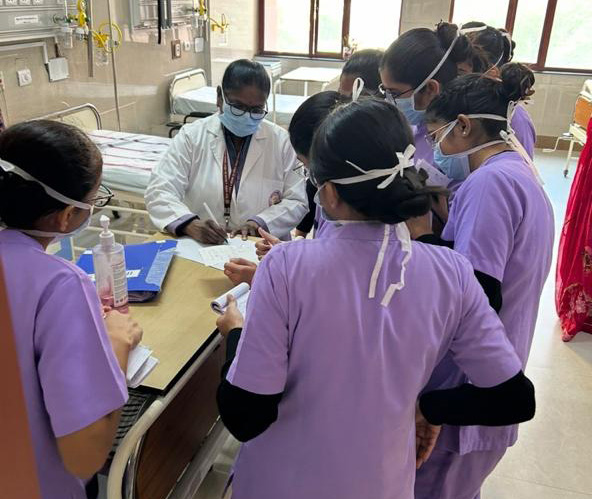
Opportunities and challenges in teaching Palliative Care to nursing students
– Dr. Latha Srikanth, Jodhpur
INTRODUCTION
When we talk about palliative care, we usually think of comfort, dignity and the small but meaningful ways in which we can ease a person’s suffering. It is not only about controlling pain or symptoms, it is also about sitting with a family that is frightened, listening to worries that are not always spoken aloud and helping people find peace during some of the most difficult moments of their lives.1 India, unfortunately, has one of the world’s highest numbers of people living with serious health-related suffering. Whether it is cancer, chronic lung or heart disease, dementia or advanced organ failure, the number of patients needing palliative care keeps increasing every year. Yet, the services available to them do not meet their needs.2
As nurses, we often stand closest to the patient. We are the ones who notice when someone is uncomfortable, anxious or scared. We guide families, coordinate care and sometimes hold a hand when words fail. But despite this central role, formal palliative care education has not always been part of nursing training in India. When I look back at my early days as a student nurse in 1991, I realise how little I truly understood about palliative care. Even when I moved through my diploma, BSc and MSc programmes, the topic was touched upon only here and there. It was only much later, during my PhD, while spending six weeks with Pallium India, that I understood how deep and meaningful this field really is.
These thoughts kept disturbing me, and I used to wonder about this essential component that every nurse must possess and why it was absent from my education, and why it is still missing for our students. Since then, I have tried, in whatever small way I can, to bring palliative care into the classroom. I spoke whenever I got the chance, at workshops, conferences, and clinical teaching, hoping that at least a few students would see what I had seen. Through this journey, I have noticed both encouraging opportunities and very real challenges. This reflection is an honest attempt to put those thoughts together.
CHALLENGES
Absence of a formal, comprehensive nursing curriculum
For many years, palliative care appeared in the curriculum only in bits and pieces, tucked away under ethics, geriatrics, oncology or communication. Students heard the terms but rarely understood what they meant in practice. Even though India slowly developed national guidelines and strategies, like the 2006 expert committee report and the 2012 national strategy, the curriculum took its time to evolve. The 20-hour module introduced by the Indian Nursing Council in 2022 was definitely a positive move,3 but let us be honest: twenty hours barely scratches the surface. Students still leave the course unsure about real-life application because they haven’t had the chance to truly experience or practise it.
Shortage of trained and qualified faculty
Another challenge is the limited number of educators who are trained or experienced in palliative care. Teaching this subject is not like teaching anatomy or pharmacology. It involves familiarity with sensitive conversations, navigating ethical dilemmas and addressing emotional and spiritual distress, all of which require real-world practice. Many nurses working in palliative care are excellent clinicians, but teaching requires a different skill set. Without well-prepared faculty, teaching becomes inconsistent and sometimes overly theoretical.
Limited clinical and training facilities
The heart of palliative care lies in the clinical setting. Unfortunately, many nursing colleges do not have access to hospices, home-care teams or dedicated palliative units. Students often finish their module without ever witnessing a family counselling session, an interdisciplinary team meeting or even a conversation about end-of-life decisions. As a result, everything remains theoretical.
A healthcare system still focused mainly on cure
Our hospitals tend to revolve around aggressive treatment, complex procedures and technology. In such an environment, approaches focused on comfort, communication and holistic care sometimes get pushed aside. This mindset also influences nursing educators, many of whom may not see palliative care as essential to patient care.
Faculty readiness and workload constraints
Teaching palliative care well takes time, case discussions, reflection, observation, and conversations. But with faculty already dealing with overloaded schedules, exam preparation, documentation and administrative duties, it becomes difficult to incorporate a new, reflective teaching approach. Without institutional support and adequate workload adjustments, we may struggle to deliver this content effectively
Limited exposure and awareness among educators
Some faculty members still associate palliative care only with the last few days of life. Others may not be comfortable teaching topics like truth-telling, decision-making or spiritual distress. In certain States, the 20-hour module is completed online with limited interaction, and the teachers who are teaching those modules may not have adequate clinical exposure to palliative care patients, which leaves students without a practical understanding.
Very few advanced education pathways
India does not yet have postgraduate programmes in palliative care nursing. Without clear career paths or recognition, young nurses may not have an opportunity to specialise in this field. Limited monetary incentives, inadequate job roles further restrict the growth of a skilled palliative care nursing workforce.
Institutional and Administrative Barriers
Many hospital administrators sometimes see palliative care as a non-revenue area. Setting up a palliative unit needs trained staff, space for counselling, equipment and community support, all of which require investment. This hesitation affects partnerships between hospitals and educational institutions and limits students’ exposure opportunities to palliative care.
Policy-level limitations
Although policies do exist in India, the way they are implemented varies widely across States. Policy makers interested in palliative care are still emerging, and funding for training, awareness, and capacity-building often falls short, which restricts opportunities for nursing education.
Cultural sensitivities around death and dying
Discussing death openly is still uncomfortable in many Indian families. Even healthcare providers hesitate to talk about prognosis. This cultural sensitivity makes it difficult for nurse educators to teach communication skills around end-of-life decision-making.
Difficulty in assessing skills
Assessing competencies in palliative care is complex. How do we measure empathy? Or a student’s ability to comfort a grieving family? Written exams cannot capture these skills. Creating good assessment tools requires time and trained faculty, which many institutions lack.
OPPORTUNITIES
Despite the challenges, I also see a way forward. Small but powerful openings where palliative care teaching easily fits in.
Integrating lessons into everyday teaching
Whenever I teach meeting basic needs of patients like nutrition, communication, comfort, hygiene or elimination and pressure injury management in nursing foundations and paediatric nursing, I naturally bring in palliative care concepts. Students start to see that palliative care is not a separate speciality. When teachers are interested, trained and well-equipped in palliative care, they can influence learning both in the classroom and during clinical supervision. This seamless integration of all the subjects will ensure that palliative care becomes a natural component of fundamental nursing education rather than an isolated topic.
Learning by observation
During clinical postings, students often observe how I speak to families and patients with advanced illness, how gently I break information or how I manage a distressed caregiver. More than any lecture, these small observations seem to stay with them, and these frequently spark further discussions, allowing students to reflect on their learning and deepen their understanding
Faculty guided Student research
I motivate students to take up small research projects in palliative care, and they begin to think more deeply about the subject. Research opens their eyes to the real issues patients and caregivers face.
Creative Learning
I motivate students to take part in palliative care-themed activities. Some of the best learning happens through informal methods. Students express palliative themes beautifully through artwork, poems, or role plays. These activities also spread awareness across the nursing institution.
Sensitisation Sessions
Short sensitisation programmes by the expert speakers in palliative care have helped clarify many misconceptions among both students and faculty.
Faculty Development programmes
Facilitating Faculty Development programs and Continuing Nursing Education can further strengthen this effort by equipping educators with the skills and confidence to incorporate palliative care into their teaching
Training at Recognised Institutions
Encouraging faculty and students to visit places like Pallium India or the Institute of Palliative Medicine and other palliative care organisations helps them gain hands-on experience, which they bring back to their classrooms.
Sharing Opportunities
I share the information whenever I get workshops, short courses, ECHO sessions and palliative conferences with the faculty and the students. Many of them have shown interest and benefited.
ECHO Learning
These sessions were very useful and created a warm and interactive learning space. Faculty and students enjoy the session and the case presentation. They get influenced by the speakers and get connected with them.
Clinical Collaborations
Encouraging the nursing colleges to form a partnership between the palliative care centres, this can be helpful for the students to transform the classroom teaching to the clinicals, even if they get a few weeks of exposure will make a huge difference.
Promoting Training Courses
Non-governmental organisations like the Institute of Palliative Medicine, Palliun India and the Indian Association of Palliative Care provide short-term and long-term courses in palliative care for doctors, nurses, physiotherapists, pharmacists, counsellors and volunteers. Interested faculty can enrol and equip themselves.
Creating job opportunities
Palliative care organisations must appoint nurse educators with a steady job, clearly defined roles and fair salaries, so more nurse teachers will choose this field and can teach and train the students who come to their organisations. This will strengthen the entire system.
Creating future Champions
Students show a natural inclination towards compassionate care; we need to recognise and give them appropriate guidance so that they can become the future leaders and advocates of palliative care.
Conclusion
Integrating palliative care into the mainstream of nursing education is not optional; it is necessary. Because “palliative care is for everyone and by everyone”, nurses working in different places will sooner or later care for someone with a life-limiting illness. Nursing students need to learn the art and science of palliative care. Therefore, teaching palliative care to students will help them to recognise that even if a cure is not possible, care is always possible.
References
- World Health Organization. Palliative care [Internet]. Geneva: WHO; [cited 2025 Feb 14]. Available from: https://www.who.int/news-room/fact-sheets/detail/palliative-care
- Ghoshal A, Joad AK, Spruijt O, Nair S, Rajagopal MR, Patel F, Damani A, Deodhar J, Goswami D, Joshi G, Butola S, Singh C, Rao SR, Bhatwadekar M, Muckaden MA, Bhatnagar S. Situational analysis of the quality of palliative care services across India: a cross-sectional survey. E cancer medical science. 2022 Dec 8;16:1486. doi: 10.3332/e cancer. 2022.1486. PMID: 36819806; PMCID: PMC9934966.
- Pallium India. Palliative care: UG nursing curriculum [Internet]. 2022 Feb 22 [cited 2025 Feb 14]. Available from: https://palliumindia.org/2022/02/palliative-care-ug-nursing-curriculum.
About the Author:

Dr A. Latha is a PhD-qualified nursing leader with 30 years of experience in clinical, teaching, and administrative roles across premier institutions. She has 25 research publications and has contributed chapters and national modules in palliative nursing education. A distinguished trainer and examiner, she is known for her expertise in paediatric and palliative care nursing.