


Palliative Care in Indian Oncology: Between Light and Shadow
– Dr. Ravi Kiran Pothamsetty, Madurai
Timing matters in oncology and palliative care
In the corridors of Indian oncology wards, I have often found myself reflecting on a question with no easy answer: “when should palliative care begin?” Should it start immediately after a cancer diagnosis, or only when oncologists recognize the need for it? What does ‘timing’ truly mean for the patient, the family, and for us as clinicians?
Having travelled alongside patients, families, and oncologists, I feel palliative care often dwells between hope and uncertainty. It moves between cure and comfort. It occupies a space I have come to recognize as one between light and shadow. I have stood outside ICU cubicles where treatment escalation was discussed faster than families could grieve and react. I have watched conversations pause, as families were presented with all the available options and asked to choose, carrying the weight of decisions so that professionals could align care with family expectations.
The Weight of Being an Oncologist
An oncologist draws on knowledge and experience in conditions of uncertainty, guiding patients through complex choices and balancing cure, control, comfort, and compassion across the cancer care spectrum.
In many Tier II and III cities, oncologists are deeply valued and often perceived as the trusted voices guiding critical treatment choices. These settings are characterised by high patient volumes, workforce instability, time constraints, and limited community awareness. Within this environment, oncologists play multiple roles simultaneously and shoulder immense responsibility.
Advances in oncology have given rise to ‘supportive oncology’ often described as a revolution in cancer care that cannot be delivered by a single clinical speciality alone.1 Yet palliative care in India continues to struggle for place and recognition in many settings. International and national consensus recommends early integration of palliative care for overall well-being.2 In real-world practice, however, such decisions are rarely simple, and are shaped by uncertainty, responsibility, and deeply held professional values.
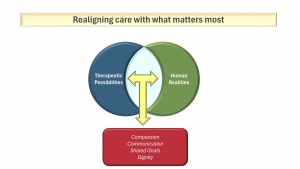
Cancer is not merely a medical diagnosis. It carries hope, uncertainty, spirit, and pause, not only for the individual but for everyone connected to them. Life is never experienced the same by everyone, and neither is cancer biology. Modern oncology has reshaped outcomes so profoundly that cancer is no longer a death sentence for many. This has eventually opened doors to endless therapeutic possibilities often ignoring the other side of the coin: “what matters most” to the person navigating this journey.
On one hand, oncological science continues to evolve and expand our capabilities. On the other, we risk depleting our capacity to listen to our inner voice. As humans, we naturally gravitate towards what can be measured and quantified. Oncologists are expected to respond to disease, honour family wishes, attempt new regimens, and strive to extend life. Any deviation from this trajectory can feel unsettling to deeply held personal and professional values. It is here that palliative care may sometimes be perceived as unfamiliar or as an ultimate step towards closure.
Hesitations for palliative care referrals
Physicians who journey closely with patients may experience internal conflicts when considering referral to palliative care. Through experience, I have come to recognize recurring tensions that quietly influence such decisions. At times, there is unease around professional identity whether involving another team diminishes one’s role as the primary clinician. There may also be emotional displacement, a concern that sharing creates distance from patient’s suffering. Occasionally, there is an unspoken fear that responsibility becomes diluted when another clinician enters the space.
These questions are rarely voiced, yet they shape everyday decisions. They are not shortcomings of intent or knowledge, but are reflections of attachment, identity, and responsibility. To refer is to share, and at times that sharing feels uncomfortably close to surrender. Recognizing these inner hesitations reframes non-referral, not as neglect, but as an ‘emotional and professional struggle’ that deserves acknowledgement and sensitive understanding.
The many faces of acceptance
Through experience, and as described in prior reflective observations on palliative care acceptance, I have come to recognize that acceptance in serious illness is not straightforward. It unfolds in multiple forms, each influencing decisions across the care journey. Patients and caregivers often move through these forms quietly seeking gentle support and guidance.
Moral acceptance – Am I being tested, or have my beliefs and prayers failed me in the face of illness?
Legal acceptance – How can formal consent or documentation carry the weight of emotions that feel deeply personal and human?
Social acceptance – Will those around me understand my decision to limit or withdraw aggressive medical interventions?
Spiritual acceptance – Is this the larger lesson of life: to arrive, to love, to endure, and eventually to depart?
Self-acceptance – Am I prepared to face the outside world without my loved one? And what becomes of those who remain − must they move forwards, or simply endure the waiting?
These forms of acceptance rarely occur in sequence. They often overlap, resist one another, and return unexpectedly.
Families, Beliefs and Instincts
In Indian families, navigating serious health-related suffering (SHS) is rarely linear. Families often withhold information from patients in an attempt to “protect” them. Bringing a loved one to the hospital can itself become an expansion of care, reassurance, and responsibility, sometimes substituting for deeper conversations about illness and prognosis. In such contexts, aggressive treatments may continue until very late in the illness in an attempt to do everything possible for those they love. In my experience, this response resembles what I have described in my previous work as an “emotional hijack.” This is not a failure of understanding or acceptance. It is an instinct to safeguard loved ones when outcomes feel uncontrollable.
Caregivers travel the cancer journey alongside their loved ones. They continue working, managing households, attending appointments, and hold together social and family responsibilities, often while setting aside their own needs. Along the way, it is human to question why this suffering has arrived and what meaning does it carry. When no clear answers emerge, many try to remain useful in whatever ways they can, hoping to support the family until very end.
These layered emotions and practical demands can quietly overwhelm caregivers and, at times, influence clinical decision-making in ways that are rarely articulated. When individuals or families are in such a state, attempts to challenge these beliefs during moments of vulnerability can feel intrusive and destabilizing rather than supportive. For clinicians too, these moments can be quietly challenging, as not every emotion demands a solution.
While modern palliative care emerged as a medical specialty in the West in the 1960s, the philosophy of holistic end-of-life care has existed in India for more than two millennia. Yet palliative care has rarely occupied a visible or central place in mainstream healthcare. A pervasive fear persists that discussing palliative care equates to “giving up”. As a result, only a small fraction of those who need palliative care in India can access it.
Modern education in India has traditionally been “disease oriented.” Death is often perceived as a medical failure. When treatment does not achieve cure or control, the experience is often perceived as defeat, rather than as an intrinsic part of the natural trajectory of illness. In this context, conversations around death are avoided rather than understood.
I have met some senior citizens both living with serious health-related suffering or otherwise well, who quietly say, “it is time to wrap up now.” I have heard similar words from younger people facing life-limiting illnesses. These expressions do not reflect a wish to die. They express a longing for relief from suffering and from prolonged uncertainty.
In such moments, thoughts related to death and dying may occasionally surface in conversations. How societies choose to engage with these thoughts remains complex, shaped by legal frameworks, moral reasoning, sociocultural norms, and spiritual beliefs. These questions rarely have simple answers.
Death itself, however, is an accepted reality in our culture. Many believe that “the one who created us will eventually call us back when the time comes.” Yet, while death is acknowledged, dignity in death is not always assured. It is within this gap that palliative care finds its role. Improving ‘death literacy’ may help to move care beyond a binary of success and failure towards meaning, purpose and dignity. These reflections often emerge not in formal consultations, but in quiet bedside moments, during pauses between emotional overload, or when families ask what lies ahead.
The words we choose and the meaning they carry
The term palliative originates from the Latin, “palliare”, meaning “to protect”. Over time, however, it has acquired confusing and often negative connotations among professionals and public. The word is commonly used across diverse clinical situations, including incurable disease, acute organ failure, and the terminal phase of illness, adding to ambiguity.
Over time, supportive oncology grew to include symptom improvement, survivorship, and palliative care. In practice, however, the term “supportive care” is often confused with “best supportive care” or used as a “gentler substitute” for palliative care itself.1 These terms are frequently used interchangeably, despite carrying distinct meanings.3 This lack of clear terminology, coupled with cultural and linguistic nuances, has further widened grey zones within Indian healthcare delivery.
Navigating integration in practice
In many Indian settings, palliative care continues to function primarily as a referral pathway rather than an integrated discipline. Poor referrals, scattered services, and lack of loco-regional consensus hinder its incorporation into routine oncology practice. High patient volumes, staff attrition, challenges in sustaining a trained workforce, and the gradual erosion of professional purpose among those who remain in the system further widen the gap between need and availability.
Palliative care in Indian oncology: sequential, referral, or concurrent from the start?
Perhaps this is not a question to be answered definitively, but one to be revisited at different points in the illness trajectory. The first step lies in deeper understanding within ourselves, before seeking answers in protocols or pathways. How do we open the door to holistic care, and how do we sit with patients when the path ahead is uncertain? How do we walk alongside both light and shadow, moving ‘from what is protocol-driven to what truly matters’ for the person, and families enduring the journey? We must also recognize the moments of greatest fear and uncertainty for caregivers, and consider how to address them gently, without adding guilt or fatigue, so that palliative care becomes naturally integrated into our everyday practice. Such questions, encountered in everyday practice, prompt reflection and help align our actions with the values of those we care for.
References
- Berman R, Laird BJA, Minton O, Monnery D, Ahamed A, Boland E, Droney J, Vidrine J, Leach C, Scotté F, Lustberg MB, Lacey J, Chan R, Duffy T, Noble S. The Rise of Supportive Oncology: A Revolution in Cancer Care. Clin Oncol (R Coll Radiol). 2023 Apr;35(4):213-215.
- Bucklar N, Schettle M, Feuz M, Däster F, Christ SM, Blum D, Hertler C. Early integration or last consultation: in-house palliative care involvement for hospitalized patients in tertiary medicine-a retrospective analysis. Support Care Cancer. 2025 Mar 5;33(4):251.
- Taylor A, Davies A. Palliative care or supportive care? Clin Med (Lond). 2025 Jul;25(4):100487.
About the Author:

Dr. Ravi Kiran Pothamsetty is a Radiation Oncologist and Consultant of Palliative Medicine, leading the institutional palliative care service embedded within the Department of Medical Oncology, at Meenakshi Mission Hospital and Research Centre (MMHRC), Madurai, Tamil Nadu. It is one of the first such models in the region.

Leave a comment