


Walking Alongside the Family: A Psychosocial Journey Through Neuropalliative Home Care
– Mr Kailash Ganga (with inputs from Dr Priya Treesa Thomas & Ms Susan John), Bengaluru
In neuropalliative care, illness is never experienced by the suffering individual alone. Progressive neurological illness gradually changes routines, relationships, roles, and responsibilities within the family. For healthcare professionals, entering a suffering individual’s home often reveals dimensions of misery that may remain invisible within the hospital. This case reflects how a small number of home-based interventions, combined with continued follow-up, can support not only the individual but also the family caring for them.
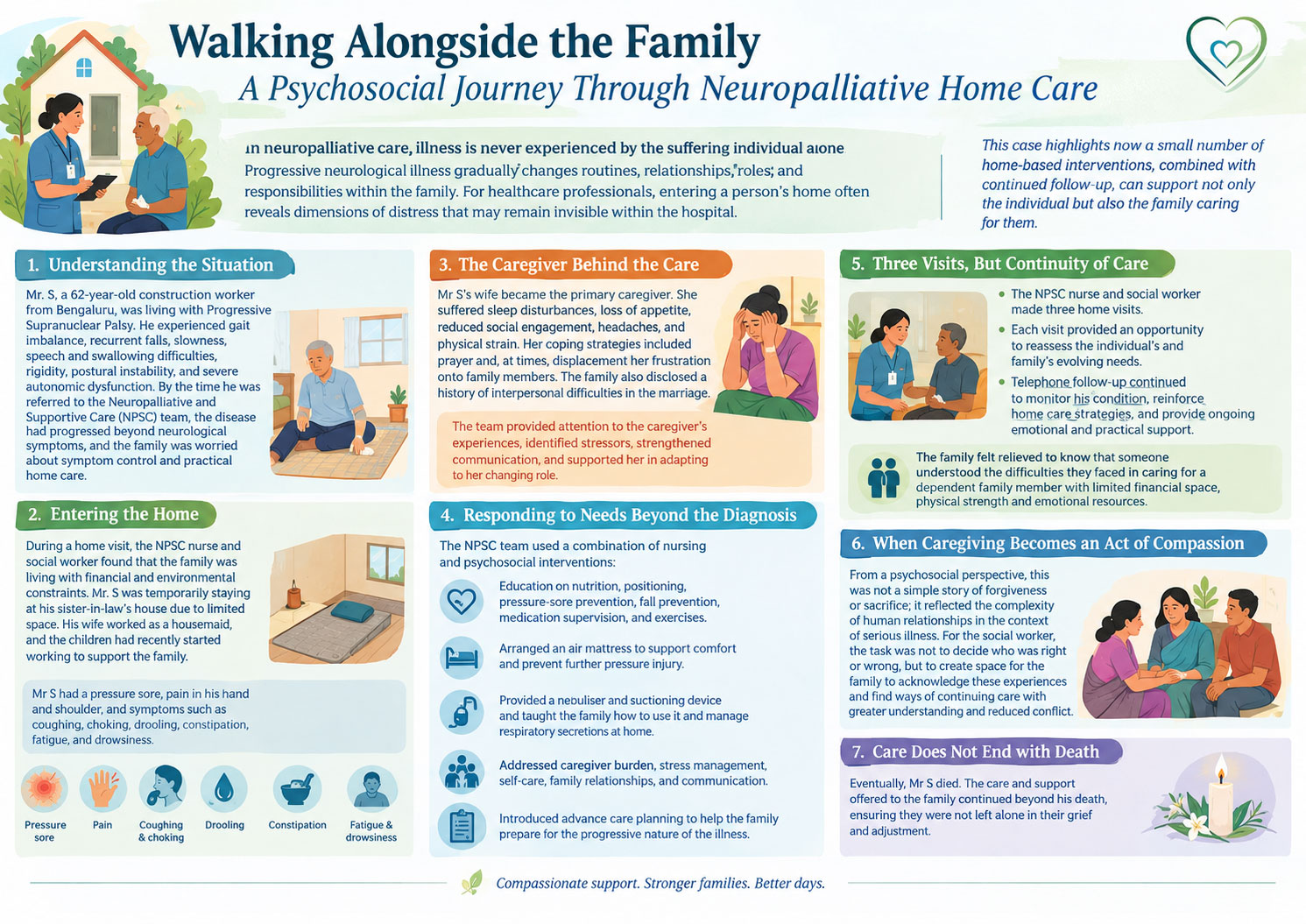
Mr. S, a 62-year-old construction worker from Bengaluru, was living with a Progressive Supranuclear Palsy characterised by gait imbalance, recurrent falls, slowness, speech and swallowing difficulties, rigidity, and marked postural instability. There was a progressive decline in functional status and reliance on family members for activities of daily living (ADLs). His cardiac autonomic system dysfunction was severe, and his clinical picture was further complicated.
At the time he was referred to the Neuropalliative and Supportive Care (NPSC) team, the disease was beyond neurological symptoms. The family was concerned about symptom management and the practical difficulties of caring for him at home.
Entering the home
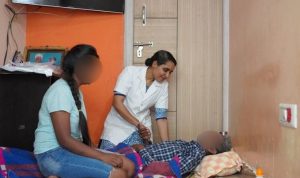
A home visit by the NPSC nurse and social worker provided an opportunity to understand Mr S’s needs in the context in which care was actually being provided. The family was living with considerable financial and environmental constraints. Because of limited space in their own home, Mr S was temporarily staying at his sister-in-law’s house. His wife was working as a housemaid, while his children had recently started working to contribute to the family’s financial needs.
The house had limited space for mobility, and the patient slept on a thin mat on the floor. He had a pressure sore over the right gluteal area, along with pain in his hand and shoulder area. He also had episodes of coughing and choking, drooling, constipation, fatigue, and drowsiness, adding to the family’s concerns about providing care safely at home.
The caregiver behind the care
Mr S’s wife had become the primary caregiver. She described sleep disturbances, loss of appetite, reduced social engagement, headaches, and physical strain since the onset of her husband’s illness.
Her coping strategies included prayer and, at times, displacement her frustration onto family members. The family also disclosed a history of interpersonal difficulties in the marriage, including episodes of abusive behaviour associated with Mr S’s earlier alcohol use. Attention was given to understanding the caregiver’s experiences, identifying sources of stress, strengthening communication, and supporting the caregiver in adapting to her changing role.
Responding to needs beyond the diagnosis
The NPSC team addressed the family’s concerns through a combination of nursing and psychosocial interventions. Mr S and his family received education regarding nutrition, positioning, pressure-sore prevention, fall prevention, medication supervision, and exercises.

Recognising the environmental barriers to care, the team arranged an air mattress to support comfort and reduce the risk of further pressure injury. Since travelling to a local clinic for nebulisation was difficult, a nebuliser and suctioning device were arranged. The family was taught how to use the device and was guided managing respiratory secretions at home.
At the same time, the social-work component focused on caregiver burden, stress management, self-care, and family relationships. Discussions were held with family members to improve communication and to understand how changing roles and caregiving responsibilities were affecting relationships within the household.
Advance care planning was also introduced to help the family prepare for the illness’s progressive nature and the possibility of increasing care needs.
Three visits, but continuity of care
The NPSC nurse and social worker made three home visits. Although the number of visits were limited, each visit provided an opportunity to reassess the evolving needs of the individual under care and family.
Telephone follow-up was continued to monitor his condition, reinforce home care strategies, and provide ongoing emotional and practical support.
The family seemed relieved to know that someone understood the difficulties they faced in caring for a dependent family member with limited financial means, physical strength, and emotional resources.
When caregiving becomes an act of compassion
From a psychosocial perspective, this does not represent a simple story of forgiveness or sacrifice; rather, it reflects the complexity of human relationships in the context of serious illness.
For the social worker, the task was not to determine who was right or wrong, but to create space for the family to acknowledge these experiences and find ways of continuing care with greater understanding and reduced conflict.
Care did not end with death
Eventually, Mr S died. However, the relationship between the NPSC team and the family did not simply end with his death.
The social worker subsequently provided grief counselling to the family. This became a natural continuation of the care journey, from supporting the individual experiencing suffering to supporting the caregiver and finally to providing bereavement support to the family.
This experience made the principle of palliative care evident. The unit of care goes beyond the individual. The emotional consequences of illness may continue long after physical symptoms have ended, and families may need support in making sense of their loss and adapting to life after caregiving.
Reflections from the home
This case reminded us that neuropalliative care is not limited to symptom management. The home visit allowed the NPSC team to see these interconnected realities.
The nurse and social worker addressed short-term physical and practical needs. The psychosocial intervention targeted caregiver burden and coping, family communication, role changes, and emotional well-being.
The most salient message was that caring can be tender regardless of the complexities of the relationships.
Neuropalliative care often takes place at the intersection of illness and everyday life. It asks us not only, “What symptoms does this individual have?” but also, “Who is caring for this person? And what can we do to ensure that neither the person nor the caregiver has to face it alone?”
In this family journey, three home visits became more than clinical encounters; They became opportunities to understand, support, connect, and prepare.
And when Mr S’s life came to an end, the care journey continued—with the family, through grief.
Because sometimes, walking alongside a family is itself an important form of palliative care.
About the Author:


Mr Kailash Ganga is a PhD scholar at the Department of Psychiatric Social Work at NIMHANS, Bengaluru, and holds an M.Phil. in Psychiatric Social Work from the same institute. With over three and a half years of experience in neuropalliative care, his work focuses on psychosocial support for people living with progressive neurological conditions and their caregivers. His professional experience includes counselling, psychotherapy, caregiver support group facilitation, home-based care, and developing caregiver resources. His professional and research interests include mental health, neurodegenerative conditions, family caregiving, and psychosocial interventions in palliative care.
Co- Authors: Dr Priya Treesa Thomas is a Professor in the Department of Psychiatric Social Work at NIMHANS, Bengaluru, and Ms Susan John is a nurse working in neuropalliative care at the same institute.



Leave a comment