


Dignity in Life, Dignity in Death
Dr Asoke Chackalacal Mathew, Chennai
Are you afraid of death? Are you ready for it?
Most of us are afraid of the unknown. Death is often spoken about in hushed voices, as though discussing it might somehow make it more real. We avoid conversations about dying, even though death is the inevitable end of every life.
Perhaps what we need is not to avoid death, but to prepare ourselves to face its reality with acceptance and grace.
“Accept with grace what we cannot change.”
One morning, I received a call from a gentleman asking me to see his aged father. His father had apparently not been taking any food for several days. I did not spend much time taking a detailed history over the phone. Instead, I decided to visit the family the following day to obtain the first-hand information.
The journey to their home was long and exhausting, as it was well outside the city limits. On arrival, the brief history showed that his father was 90 years old, lived with diabetes mellitus and chronic obstructive pulmonary disease (COPD), and had been on treatment for many years.
What I saw shocked me when I entered the bedroom – elderly man profoundly emaciated and dehydrated- all skin and bones, curled up on the bed. He was unconscious, barely breathing, and inadequately covered by a lungi. Both his upper arms showed extensive bruising and hemorrhagic extravasation, possibly from repeated attempts at intravenous access. His pulse was feeble. His blood pressure and oxygen saturation were not recordable and he was gasping for breath.
For a moment, words simply got stuck in my throat.
I was looking at a human being in the final stages of life, but what struck me most was not merely the severity of his medical condition. It was the loss of dignity surrounding him.
Was this ignorance? Was it neglect? Was it helplessness? It was difficult to define.
But the experience made me think deeply about dignity in life—and dignity in death.
How do we educate caregivers about the dying process? How do we break bad news when the family is desperately hoping for a cure? How do we explain that, sometimes, the goal of medicine must change from prolonging life to ensuring comfort and dignity?
The family had called me because they believed that a palliative care physician was someone who would be able to “do something”—revive their father, make him eat and drink, and somehow improve his condition.
Their understanding of palliative care was clearly very different from what palliative care actually means.
I explained that their father appeared to be on the downward journey towards the end of life. Their greatest concern still was “Doctor, you are the doctor. Please do something. At least make him drink some water.”
This is one of the most difficult situations faced by palliative care physicians.
There may be very little that medicine can do to reverse the underlying process, yet the family is asking the physician to intervene. Their request often comes from fear, love, guilt and helplessness.
Earlier in his illness, options such as hospital admission and artificial feeding through nasogastric tube had been discussed with the family. However, they were not willing. Now, at this very late stage, they were hoping for an intervention that would reverse what was happened.
This is where the principles of palliative care and medical ethics become particularly important.
We spoke about autonomy, beneficence, non-maleficence, justice and, above all, dignity. But initially, they were not ready to listen. They were overwhelmed by the possibility of losing their father. In fact, they were afraid of death. And perhaps that fear was speaking through their words.
Instead of continuing to explain medical terminology, we changed the conversation. We talked about what could still be done for their father –doing something does not always mean starting another treatment. Sometimes, doing something means making a person comfortable.
We encouraged them to dress him properly and cover him with dignity. To sit beside him and talk to him, even if he did not respond. To speak lovingly to him and, if he was able to swallow safely and wished to take fluids, offer small amounts without forcing him.
We reminded them that even when a person can no longer communicate, our presence may still matter. If he enjoyed music, they could play his favorite songs. If there was a close friend or relative whom he loved, they could invite that person to be near him. They could hold his hand. They could talk about familiar memories. They could simply sit quietly beside him. These may appear to be small things. But at the end of life, they can mean everything.
The focus had shifted—from trying to make him eat, to making sure he was comfortable; from trying to reverse death, to accompanying him through it; from asking “What more can medicine do?” to asking “What more can we do for him?”
This is the essence of palliative care.
Palliative care does not mean giving up. It does not mean abandoning the patient when treatment is no longer possible. It means recognizing what the patient needs at that particular stage of life and responding with compassion.
There are times when we can cure.
There are times when we can prolong life.
And there are times when neither is possible.
At those moments, we can still care.
We can relieve pain and distress. We can provide comfort. We can support the family. We can help them understand what is happening. And most importantly, we can ensure that the person does not lose his dignity simply because he is dying.
Death is inevitable. But suffering, abandonment and indignity need not be.
Perhaps the greatest lesson from that visit was that the family’s request to “do something” was not wrong. They simply did not yet understand what something could mean.
As healthcare professionals, our responsibility is not only to treat disease but also to help families understand when the goals of care need to change.
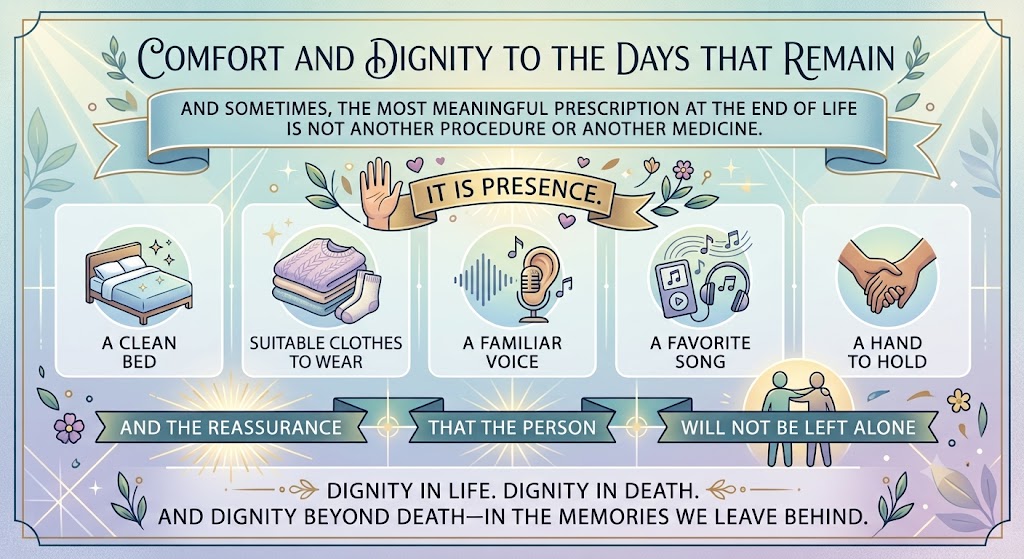
When we cannot add days to life, we can still add life, comfort and dignity to the days that remain. And sometimes, the most meaningful prescription at the end of life is not another procedure or another medicine.
It is presence.
A clean bed.
A well-covered body.
A familiar voice.
A favorite song.
A hand to hold.
And the reassurance that the person will not be left alone.
Dignity in life. Dignity in death. And dignity beyond death—in the memories we leave behind.
About the Author:
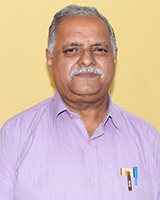
Dr Asoke Chackalacal Mathew currently serves at SEARCH Foundation & Lakshmi pain and palliative Care Trust,Chennai. He also serves as Coordinator & consultant Palliative Care, Chennai Bangalore Mathoma Diocesan, Chennai.

Leave a comment